


- Home
- About
- Practice Areas
- Business and Corporate Law
- Business Formation and Structuring
- Asset and Stock Purchases and Sales
- Trademark and Copyright
- Mergers & Acquisitions
- Business Valuations and Buyouts
- Business Financing and SBA Loans
- General Counsel Services
- Founders Agreements
- Shareholder Agreements
- Non-Compete, Non-Solicitation, and Non-Disclosure Contracts
- Joint Venture Agreements
- Licensing
- Asset Protection
- Franchise Agreements
- Business Dissolution and Restructuring
- Business and Commercial Litigation
- Real Estate
- Real Estate Fraud & NVAR Residential Sales Contracts
- Construction Disputes & Mechanics Liens
- New Home Construction and Builder Contract Disputes
- Asset Protection
- Easements
- Boundary Line Disputes
- Quiet Title Actions
- Adverse Possession Claims
- Injunctions, Nuisance, and Trespass Claims
- Title Litigation
- Real Estate Deeds
- New Deed Request
- Commercial Property Acquisitions, Sales, and Development
- Commercial Leasing Disputes
- Landlord-Tenant Disputes
- Real Estate Brokers & Agents
- Condominiums, HOA & Cooperatives Law
- Partition/Allotment Actions
- Mold, Asbestos, and Toxic Torts Defense
- Hard Money Loan Agreements
- Real Estate Investors
- Property Managers
- Wholesaling Agreements
- Estate Planning
- Estate and Trust Litigation
- Business and Corporate Law
- Media
- Blog
- Contact Us


301-409-5316
 Attorney Profile
Gaithersburg Defamation Attorneys
"I'm glad I chose Fox & Moghul and truly appreciate their professionalism and exceptional service. Special thanks to the amazing team, you guys exceeded my expectations with your support and dedication. I highly recommend Fox & Moghul and look forward to working with them again!"
Protect Your Investments Contact Our Team Today
 The use of the Internet or this form for communication with the firm or any individual member of the firm does not establish an attorney-client relationship. Confidential or time-sensitive information should not be sent through this form.
I have read and understand the Disclaimer and Privacy Policy.
Lawyers Helping Businesses Address Defamation Through Litigation in Gaithersburg, MD
A business depends on its reputation to attract customers, maintain relationships with vendors, and compete within its industry. When someone spreads false information about a company, its reputation can suffer, leading to reduced revenue, lost business opportunities, and other forms of harm. Problems may begin to affect a business before the owner or other stakeholders even become aware of what was said. Businesses will need to understand how to address false statements made by competitors, former employees, customers, or members of the public through defamation lawsuits.
When defamation has occurred, the team at Fox & Moghul can provide legal representation for a business during litigation. These cases involve specific legal standards, filing procedures, and requirements related to evidence. We can provide guidance on the steps that can be followed to pursue a defamation claim, recover compensation for losses and other damages, and protect a business's reputation and goodwill. We can also help defend against defamation claims when necessary.
Effective Representation for Businesses in Defamation Disputes
As we address defamation, our lawyers will take steps work to connect false statements to actual financial and reputational harm suffered by a company. We can review sales records, communications with customers, marketing data, and other factors to ensure that we understand the full scope of the damages that have occurred. We can present persuasive evidence in court while advocating for solutions that will protect our clients' interests.
Our team has the experience needed to ensure that matters related to litigation will be handled correctly. We have represented clients in a wide variety of business disputes, and we have won numerous awards that have recognized the value we provide to our clients. Our attorneys regularly lead seminars, workshops, and other forms of legal education to pass on our knowledge to other legal professionals. We have an unparalleled level of knowledge and experience in these matters, and clients who work with us can rest assured that they will be able to resolve legal disputes successfully.
Situations That May Lead to Defamation Claims
Businesses may need to address defamation in a variety of circumstances. In some cases, a competitor may spread false rumors about a business's practices in an attempt to convince customers to take their business elsewhere. In others, a former employee may post false statements on social media after leaving a company, accusing the business of engaging in illegal or unethical conduct. Former customers may publish online reviews that go beyond opinions and include falsified information that is intended to damage a business. Others may make public statements that falsely claim that a business has engaged in fraud, committed safety violations, or taken other illegal or unethical actions.
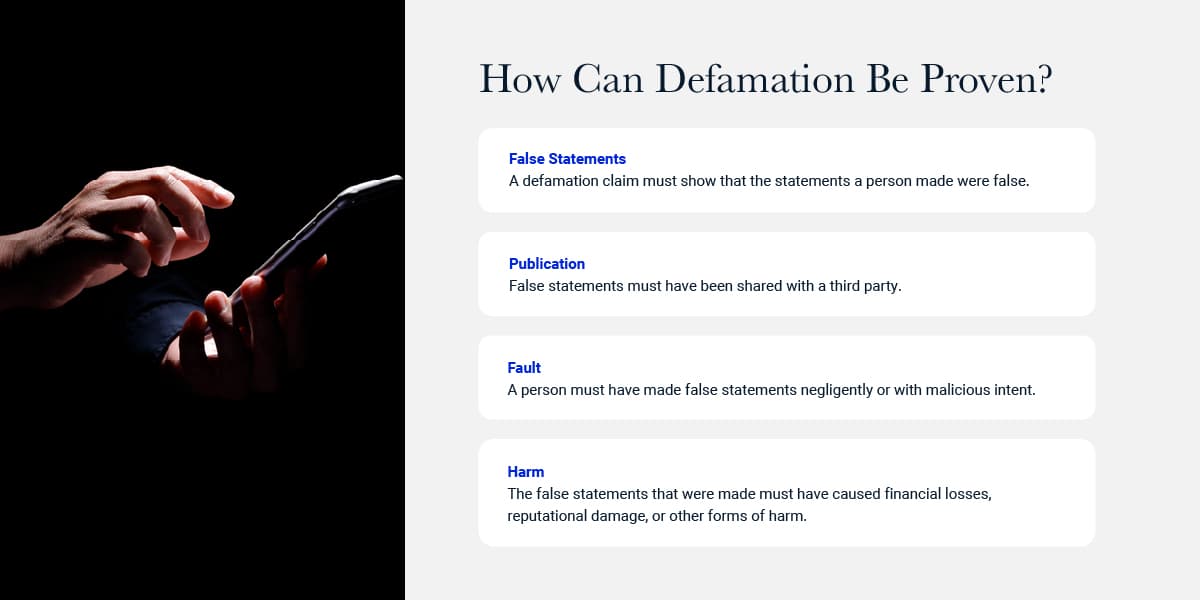
Negative comments may not necessarily support legal claims of defamation. A statement must be false, and it must be presented as fact rather than opinion. A person's statements must have caused harm to a business, including damage to its reputation or actual financial losses. Our lawyers know how to prove that these criteria have been met, and we will work to ensure that our clients can obtain relief that will address the damage caused by defamation.
How Defamation Lawsuits Are Handled
When a business decides to pursue a defamation claim, the steps followed in a case will generally include:
Initial Case Evaluation
Our attorneys will review the statements that have been made to determine whether they qualify as defamation. We can identify the parties who made false statements and evaluate the losses or other damages that have occurred. This can help ensure that we will be able to pursue a lawsuit that will address defamation and the harm it has caused.
Filing a Complaint
A lawsuit will begin when a formal complaint is filed in the appropriate Maryland circuit court. The complaint will outline the false statements that were made and describe the harm suffered by the business. The defendant will be formally notified of the lawsuit, and the case may then move forward.
Discovery Process
Our lawyers will take steps to uncover all information that may be relevant to a case. We may take steps to obtain emails, social media posts, financial records, witness statements, and other evidence. If necessary, we can conduct depositions or issue subpoenas, and we will gather information to ensure that we understand the statements that were made, whether they were false, whether a person intended to cause harm, and the full scope of the damages that occurred.
Resolution Through Settlement or Trial
A defamation case may be resolved through the negotiation of a settlement. We will work to ensure that an agreement will meet our client's needs. If a settlement cannot be reached, the case will proceed to trial. We will argue on a client's behalf before a judge or jury, taking steps to show that defamation occurred and advocating for remedies that will fully address the damages that have occurred.
Excellence Always

Legal Issues That May Arise in Defamation Cases
Maryland has a one-year statute of limitations for defamation claims, so a lawsuit must generally be filed within one year after a defamatory statement was made. Courts may look at whether false statements were made with actual malice or involved accusations of criminal conduct, professional dishonesty, or unethical conduct or whether it will be necessary to demonstrate that statements were defamatory and led to harm.
Recovering Compensation and Preventing Future Harm
When a court finds that defamation occurred, a business may be compensated for its financial losses, including lost sales, lost contracts, and the costs of repairing its reputation. Courts may also issue orders requiring the removal of false statements from websites or social media platforms, and they may issue orders prohibiting the defendant from making similar statements in the future. These measures can help prevent a business from suffering harm while it works to restore its reputation.
Frequently Asked Questions About Defamation Litigation FAQs
Answer: A statement of fact is based on something that can be proven to be true or false. For example, an accusation of illegal conduct can be proven to be false by showing that no crime has occurred. An opinion will reflect a personal viewpoint rather than a factual statement. Opinions are generally protected, and defamation cases can typically only address false statements of fact.
Answer: In some cases, a business may be compensated for presumed damages. When false statements are egregious or are made out of malice, the harm done to a business may be self-evident, and the defendant may be required to pay compensation. However, evidence of actual harm may strengthen a case and ensure that specific losses due to defamation will be addressed.
Answer: The timeline for resolving a lawsuit will depend on the complexity of the case and whether the parties can reach a settlement. Some cases may be resolved within a few months as the parties negotiate an agreement outside of court. However, the process will likely take longer if a case proceeds to trial.
Answer: It is important to preserve evidence of defamatory statements, including screenshots, copies of written communications, and the names of anyone who witnessed or received a statement. While it may be possible to respond to online reviews or take other steps to resolve issues that led to defamatory statements, any attempts to threaten or intimidate a person into taking down or retracting their statements could affect the outcome of a lawsuit. By consulting with an attorney after learning about defamation, a business can make sure the right steps will be taken to address the issue.
Contact Our Gaithersburg, Maryland Business Defamation Lawyers
False statements can spread quickly, and they can cause extensive damage that may affect a business for years. At Fox & Moghul, our lawyers can review statements that have been made, advise business owners of their legal options, and provide effective representation during litigation. Contact our Gaithersburg defamation litigation attorneys at 301-409-5316 to arrange a consultation and discuss the steps that can be taken to protect a company's reputation.
