


- Home
- About
- Practice Areas
- Business and Corporate Law
- Business Formation and Structuring
- Asset and Stock Purchases and Sales
- Trademark and Copyright
- Mergers & Acquisitions
- Business Valuations and Buyouts
- Business Financing and SBA Loans
- General Counsel Services
- Founders Agreements
- Shareholder Agreements
- Non-Compete, Non-Solicitation, and Non-Disclosure Contracts
- Joint Venture Agreements
- Licensing
- Asset Protection
- Franchise Agreements
- Business Dissolution and Restructuring
- Business and Commercial Litigation
- Real Estate
- Real Estate Fraud & NVAR Residential Sales Contracts
- Construction Disputes & Mechanics Liens
- New Home Construction and Builder Contract Disputes
- Asset Protection
- Easements
- Boundary Line Disputes
- Quiet Title Actions
- Adverse Possession Claims
- Injunctions, Nuisance, and Trespass Claims
- Title Litigation
- Real Estate Deeds
- New Deed Request
- Commercial Property Acquisitions, Sales, and Development
- Commercial Leasing Disputes
- Landlord-Tenant Disputes
- Real Estate Brokers & Agents
- Condominiums, HOA & Cooperatives Law
- Partition/Allotment Actions
- Mold, Asbestos, and Toxic Torts Defense
- Hard Money Loan Agreements
- Real Estate Investors
- Property Managers
- Wholesaling Agreements
- Estate Planning
- Estate and Trust Litigation
- Business and Corporate Law
- Media
- Blog
- Contact Us


703-652-5506
 Attorney Profile
Washington, D.C. Business Law Attorneys
"The lawyers at this firm are extremely skilled with business law matters. I am extremely happy with their representation in my complex business case. Special thanks to Faisal Moghul for his amazing advice and professionalism throughout."
Protect Your Investments Contact Our Team Today
 The use of the Internet or this form for communication with the firm or any individual member of the firm does not establish an attorney-client relationship. Confidential or time-sensitive information should not be sent through this form.
I have read and understand the Disclaimer and Privacy Policy.
Lawyers for Business Formation, Contracts, Buyouts, and More in Washington, D.C.
To ensure that they can operate successfully, businesses in Washington, D.C. may need to address a wide variety of legal concerns. The contracts a business puts in place may affect its relationships with other parties while protecting the rights of business owners and partners. A business's growth plan will need to account for the laws and regulations that may affect its operations and long-term success.
Business owners, partners, and shareholders may encounter multiple types of legal concerns. Taking the right steps when establishing a new company, restructuring to meet changing marketplace conditions, acquiring or merging with another company, or handling a buyout can make sure the rights and interests of stakeholders will be protected.
At Fox & Moghul, our business law attorneys can help business owners, partners, investors, executives, and other stakeholders address legal concerns that may affect their business strategies and operations. We work to ensure that companies can handle legal matters correctly before disputes arise. By addressing issues related to contracts, corporate governance, internal policies, regulatory matters, and transactions, we can help to reduce risk, protect business assets, and ensure that our clients can achieve their business goals.
Business Formation and Entity Selection
During the business formation phase, some of the most important decisions made will be related to a company's legal structure. An owner or partners may choose to structure a business as a limited liability company (LLC), corporation, partnership, or other type of entity. The proper steps will need to be followed to establish and register a business entity while meeting ongoing reporting requirements.
Our lawyers can help clients determine what type of business structure will provide the best fit for a companys goals. We can provide guidance on issues such as liability protection, tax treatment, management flexibility, securing financing from investors or other sources, and the steps that will be followed when bringing new partners into a company. For existing companies, we can assist with restructuring when necessary to ensure that a business can continue to operate successfully.
General Counsel Services for Ongoing Business Needs
A business may need continuing legal guidance on certain matters, but it may not be able to hire a full-time in-house attorney. Our general counsel services can help ensure that a business will have legal help when needed. The ongoing services we provide to businesses may include contract drafting, reviewing employment-related documents, negotiating agreements with vendors, regulatory compliance, and the resolution of business disputes.
Business Contracts and Legal Agreements
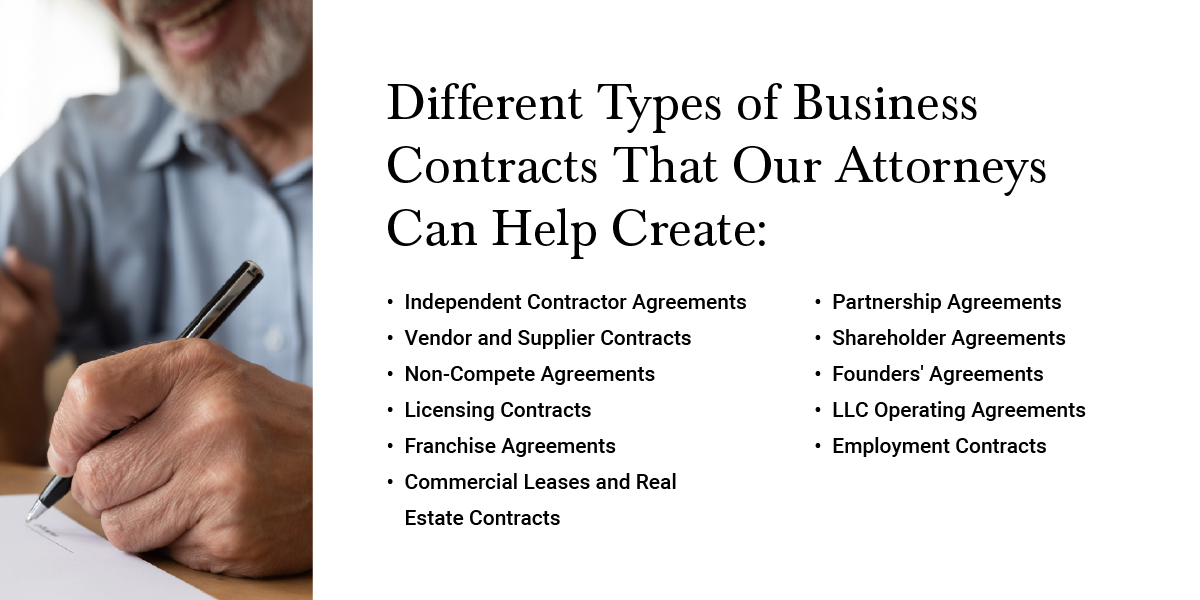
Businesses may enter into multiple types of legal agreements, and they will need to make sure contracts are drafted correctly. Contracts will define the rights and responsibilities of the parties while also detailing payment terms and other expectations. Poorly written contracts can lead to confusion, lost revenue, damaged business relationships, or litigation. Our attorneys can work with clients to draft, review, negotiate, and revise agreements such as:
- Partnership Agreements or LLC operating agreements: These contracts may address issues such as ownership percentages, voting rights, profit distributions, management authority, buyout rights, and procedures for resolving disputes.
- Shareholder Agreements: These agreements may cover issues such as share transfers, voting rules, minority shareholder protections, and what will happen after the death, disability, retirement, or termination of shareholders or other stakeholders.
- Franchise Agreements: Companies that enter into franchise relationships will need to make sure the legal agreements put in place address issues such as brand use, territory rights, operational standards, training obligations, and advertising requirements.
- Non-Compete and Non-Disclosure Agreements: These agreements may be used to protect business relationships, trade secrets, and confidential information. It is important to make sure the terms of these agreements are reasonable and have been put in place to protect legitimate business interests. Agreements that are too broad or too restrictive may not be legally enforceable.
Mergers, Acquisitions, Valuations, and Buyouts
When one company acquires or merges with another company, the right steps will need to be taken to ensure that continuity of operations can be maintained and that the combined businesses will be able to operate successfully. Our lawyers can help ensure that the right steps are followed during mergers and acquisitions, and we can assist with due diligence, letters of intent, purchase agreements, and post-closing obligations. We advise clients on how to ensure that these transactions will support their long-term goals.
Business valuations and buyouts may need to be addressed when an owner or partner exits a company, when one or more parties buy out the shares of other investors, or when a company is preparing for sale. A valuation may need to consider revenue, assets, debts, goodwill, intellectual property, market position, and future earnings and growth. Our attorneys can help clients structure the terms of a buyout, address potential liabilities, and prepare documents that will help to reduce the risk of disputes.
Asset and Stock Purchases and Sales
A business transaction may be structured as either an asset or stock purchase. An asset purchase will allow a buyer to acquire specific business assets, such as equipment, inventory, customer contracts, or intellectual property. A stock purchase or equity sale will generally transfer ownership interests in the company itself. Each option may have different consequences that can affect contracts, taxes, liabilities, employees, and licenses.
Our lawyers can help buyers and sellers understand their options during a business transaction. We can explain the benefits and risks of asset or stock purchases and sales, and we will prepare documents that clearly state what is being transferred, who will be responsible for liabilities, and other important information.
Trademark, Copyright, and Licensing Issues
The intellectual property owned by a business may be some of its most valuable assets. Trademarks may protect names, logos, slogans, and brand identifiers, while copyrights may protect original works such as website content, software, designs, marketing materials, and creative media. Taking steps to protect trademarks and copyrights can help ensure that a business will be able to avoid infringement or other issues that could lead to financial losses or reputational damage.
Our attorneys can assist with the registration of trademarks and copyrights, and we can address infringement concerns or other issues that may affect brand protection. We can also help establish licensing agreements that will allow a business to generate revenue by allowing others to use intellectual property. We can make sure these agreements clearly address issues such as scope of use, duration, fees, quality control requirements, termination rights, and ownership of derivative works.
Excellence Always


Business Dissolution and Restructuring
When a business closes or reorganizes, multiple types of legal issues will need to be addressed, and they must be handled carefully to make sure the rights of all stakeholders are protected. A business dissolution may require the approval of an owner, partners, or shareholders. The proper documents will need to be filed with the District of Columbia or other government bodies. Creditors will need to be notified so that debts can be resolved. A business's remaining assets may need to be distributed, and existing contracts may need to be terminated.
If a business will be restructuring, issues related to ownership, management roles, assets, debts, and contracts may need to be addressed. Our lawyers can help businesses manage transitions while protecting owners from liability and ensuring that all legal matters will be addressed correctly.
Frequently Asked Questions About Business Law Matters
Answer: The appropriate structure for your business may depend on several factors, including liability concerns, tax issues, management preferences, and long-term plans. At Fox & Moghul, we can advise you on whether structuring a business as a limited liability company, corporation, or partnership may be beneficial. An LLC may provide flexibility and liability protection, while a corporation may be more appropriate for a business that is seeking investors. We will help you evaluate your options and explain the legal and financial issues that will need to be addressed during the business formation process.
Answer: Business disputes may arise due to issues such as unclear contracts, poor documentation, or compliance problems. At Fox & Moghul, our attorneys can help companies identify legal risks before they escalate into disputes that may lead to litigation. We can assist with contract review, provide guidance on employment policies, and help a business maintain regulatory compliance. If necessary, we can provide representation during business litigation, helping our clients resolve disputes successfully.
Answer: In an asset purchase, the buyer may acquire specific business assets, such as equipment, inventory, contracts, or intellectual property. In a stock purchase, a buyer will acquire an ownership interest in the company itself, and they may assume certain rights and liabilities. Our lawyers can help businesses determine which approach to take during transactions and help them take steps to achieve their goals.
Answer: A company may consider a change in structure because of changes in ownership, management disputes, or expansion plans. Restructuring may also occur during mergers and acquisitions or buyouts. Our attorneys can provide guidance on when and how to restructure a business, and we can make sure all legal requirements are met during the restructuring process
Answer: Washington, D.C. has laws that restrict the use of non-compete agreements in certain situations involving employment. The enforceability of a non-compete agreement can depend on factors such as the restrictions placed on a person, the compensation provided in exchange for signing an agreement, and whether the agreement was necessary to protect a legitimate business interest. Our lawyers can review restrictive covenants and make sure they will be enforceable while protecting a business's interests.
Answer: Yes. Small businesses may encounter legal issues related to contracts, employment matters, vendor relationships, regulatory compliance, or business disputes. Ongoing legal guidance can help business owners make informed decisions and avoid costly mistakes.
Contact Our Washington, D.C. Business Lawyers
Legal concerns can affect businesses of all sizes and at every stage of a companys life cycle. Addressing these matters correctly can help ensure that a business will be able to operate successfully. The team at Fox & Moghul can provide guidance for business owners, partners, shareholders, and other stakeholders, ensuring that they take the right steps to achieve their goals. Contact our Washington, D.C. business law attorneys at 703-652-5506 to arrange a consultation.
